GG-2026-082
Houghton Mansion
- Phenomenon Apparitions & Spirits, Auditory & Acoustic Events
- Documentation
Rating C
- A — Strong dossier: several independent sources plus primary evidence (original media, records, measurements) a researcher could use without interviewing anyone.
- B — Well documented: multiple independent witnesses with at least some contemporary primary material, or one witness with substantial primary corroboration (photos, recordings, contemporaneous notes, documents).
- C — Multi-source but soft: several witnesses or a long run of reports, but mostly testimony and after-the-fact secondary sources (newspapers, folklore collections, later interviews). Little or no primary physical evidence. Regional legend clusters such as the Bridgewater Triangle land here.
- D — Thin: single witness (or one household), little or no support beyond the account. Normal for a sincere personal experience.
- E — Incomplete or not yet assessed. Every new submission starts here until staff have read it.
- Evidence & media 2 items
- Status Active
- Location North Adams, Massachusetts
- Occurred 1 August 1914
Summary
Located on Church Street in North Adams, Massachusetts, the Houghton Mansion stands as a prominent late 19th-century Neo-Classical residence bound to one of New England's most heartbreaking early 20th-century tragedies. Constructed in the 1890s by Albert Charles Houghton—a wealthy industrialist, president of Arnold Print Works, and the first mayor of North Adams—the mansion was home to the influential Houghton family. On August 1, 1914, a devastating automobile accident in Bennington, Vermont, fatally injured Albert’s daughter Mary Houghton, family friend Sybil Hutton, and trusted chauffeur John Widders. Consumed by overwhelming guilt over the crash, Albert Houghton died ten days later, while his grief-stricken chauffeur committed suicide in the mansion's barn. Transformed into a Masonic Temple in 1926 and later sold to private preservationists, the home has long earned a reputation as one of the Berkshire region's most active hauntings, with visitors and investigators reporting full-bodied apparitions, cold spots, disembodied footsteps, and unexplained electronic voice phenomena (EVP).
Background
The Tragedy of August 1914
In the spring of 1914, Albert Houghton purchased the family's first automobile, a 7-passenger Pierce-Arrow, and hired long-time trusted employee John Widders to serve as chauffeur. On August 1, 1914, Widders drove a party consisting of Albert Houghton, his adult daughter Mary, family friend Sybil Hutton, and Mrs. Hutton's daughter on a scenic drive toward Bennington, Vermont:
The Crash: While driving along a road under repair in Pownal, Vermont, the Pierce-Arrow hit soft shoulder earth at low speed, sending the heavy vehicle tumbling down a steep 20-foot embankment.
The Fatalities: Mrs. Hutton died at the scene. Mary Houghton suffered fatal internal injuries and passed away hours later at North Adams Hospital.
The Aftermath: Devastated by the loss of his daughter and friend, Albert Houghton’s health rapidly declined, leading to his death on August 11, 1914, at age 70. Overcome with guilt over his role in the accident, John Widders took his own life in the mansion's carriage house/barn on August 2, 1914.
Timeline of Key Events
├── 1890s : Mansion constructed for Albert C. Houghton and family in North Adams, MA.
├── August 1, 1914 : Pierce-Arrow automobile accident in Vermont fatally injures Mary Houghton & Sybil Hutton.
├── August 2, 1914 : Chauffeur John Widders dies by suicide in the mansion's carriage house.
├── August 11, 1914 : Albert Houghton dies inside the mansion following severe health collapse.
├── 1926 : Property sold to the local Masonic Order (Lafayette Lodge), serving as a temple.
└── Present : Maintained for historical tours, events, and paranormal investigations.
Modern Anomalous Reports
After serving for decades as the meeting site for the Lafayette Lodge of Masons—during which a large brick lodge hall was added to the rear structure—the building developed a national reputation for anomalous occurrences:
Apparitions and Shadow Figures: Caretakers and tour groups report seeing dark shadow figures moving across the upper balconies, basement corridors, and former servant quarters. Full-bodied figures wearing early 20th-century attire are frequently reported on the main staircase and library.
Auditory Anomalies: Investigators regularly record disembodied voices, whispering, and distinct footsteps pacing empty second-floor bedrooms. Acoustic phenomena include the sound of a vehicle engine or car door slamming near the rear carriage house despite no physical vehicles present.
Tactile and Environmental Shifts: Visitors routinely experience sudden draft drops exceeding 15°F in localized areas, light fixtures dimming or flickering on command, and feelings of physical pressure or unseen hands touching shoulders in the former carriage house area.
Witness statement
No statement on file.
Evidence & media
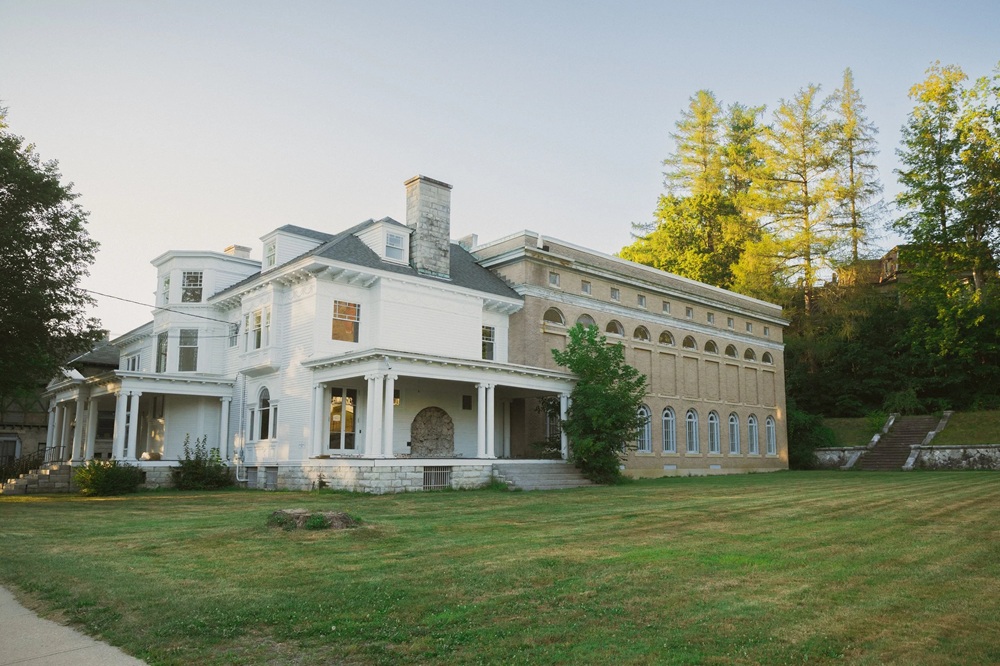 Houghton Mansion today.
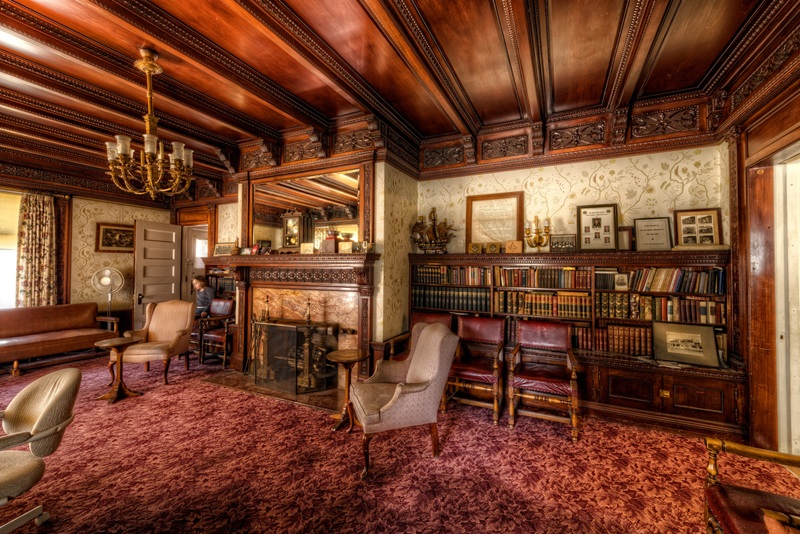 Interior shot.
Investigation timeline
- 2026-09-28 — Historical file submitted.
- 2026-09-29 — Historical file accepted and published.
Research notes
Historical research: Architectural Resonance, Thermal Dynamics, and Historical Trauma Priming
From environmental design, industrial history, and environmental psychology perspectives, the Houghton Mansion provides a clear case study in structural aging, acoustic reverberation, and cultural priming.
The physical building features sprawling timber framing, high ceilings, complex masonry additions, and expansive subterranean spaces from its Masonic era conversion. Environmental engineers note that historic structures situated near the Hoosic River valley experience significant seasonal thermal shifts and subterranean air drafts; these natural pressure differences create settling creaks, sudden temperature drops (cold spots), and door movements often misattributed to supernatural force. Additionally, visitors entering the mansion are almost universally briefed on the double-tragedy of 1914, creating a high degree of psychological priming. In conditions of low ambient light during nighttime tours, ambient house vibrations, shadow angles from streetlamps, and auditory background noise are readily interpreted through the lens of grief and historical tragedy.
Historical research: Guilt-Induced Trauma Imprinting, RSPK, and Instrument-Based Field Research
In parapsychology and anomalistic research, the Houghton Mansion is studied as an example of acute psychological trauma imprinting tied to sudden violent loss and remorse.
Researchers focus on the dual psychological vectors associated with the case: the violent physical shock of the automobile accident and the severe guilt experienced by Albert Houghton and John Widders in the immediate 24 to 48 hours following the event. Parapsychological theory explores whether such intense, localized emotional distress leaves a persistent psychical impression on physical surroundings. Instrumental field studies at the location frequently deploy electromagnetic field (EMF) meters, thermal imaging cameras, and digital audio recorders (EVP generation). Field groups regularly report anomalous low-frequency magnetic fluctuations in areas absent of active wiring, alongside coherent audio responses corresponding to historical queries about the 1914 accident.
Propose evidence & media, a source citation, further reading, a research note, a correction, a related case, or a series link. Staff review before anything is added. An accepted correction does not replace the file by itself.