Activity period
- Earliest claimed event 1970
- Earliest documented report Unknown
- Latest documented report Ongoing
- Pattern Recurring
Summary
Boston Common (laid out 1634) and the Central Burying Ground on its Boylston edge (1756) hold deep documented history — hangings at the Great Elm, British occupation, civic life, and a burial ground for many who lacked elite plots. Nineteenth-century street work and 1895 subway digging disturbed and reinterred remains; a mass grave marker still records the subway finds. Ghost lore (execution-site figures, colonial forms, a silent girl, trackside soldiers) is widespread on tours but mostly anecdotal. History is firm; haunt cause is open.
Background
Boston Common is generally cited as the oldest public park in the United States (1634): pasture, muster ground, gathering place, and for long stretches a site of public punishment. The Great Elm served for generations as Boston’s principal hanging tree; its former ground is a frequent hook for later apparition stories (colonial dress, hanging forms that vanish, night voices). British troops used the Common in the Revolutionary period. Those uses are historical; the ghosts attached to them are folklore.
Central Burying Ground opened in 1756 as Boston’s fourth major cemetery, along the Common’s southern edge. It received many without family tombs elsewhere — immigrants, strangers, the poor — as well as some better-known burials (e.g. painter Gilbert Stuart; Tea Party participants appear in civic lists). City history notes burials disturbed when Boylston Street was improved (1830s): tombs removed and remains reinterred in a western double row. In 1895, Tremont/Boylston subway excavation uncovered further tombs and unmarked remains; those were consolidated in a large grave in the northwest of the yard, marked by a slate tablet. Tour lore often calls the subway dead British soldiers from the occupation or Bunker Hill; official city text says some British officers are *believed* buried at Central but that fact *cannot be confirmed*, and the 1895 tablet speaks of persons found under the mall during subway digging — not a proven redcoat trench ID.
Haunt claims include colonial figures among stones, shadows, emotional “crowding,” Green Line operators’ stories of uniformed men on tracks near Boylston, and a 1970s encounter attributed to Boston dentist Matt Rutger (also spelled Rutger in retellings): a silent girl in a dirty white dress appearing in different corners, touches/collar pull, keys taken or dropped — published in later ghost books (e.g. Nadler, Revai, Baltrusis), not as a 1970s newspaper primary in the sources checked here.
Witness statement
No statement on file.
Evidence & media
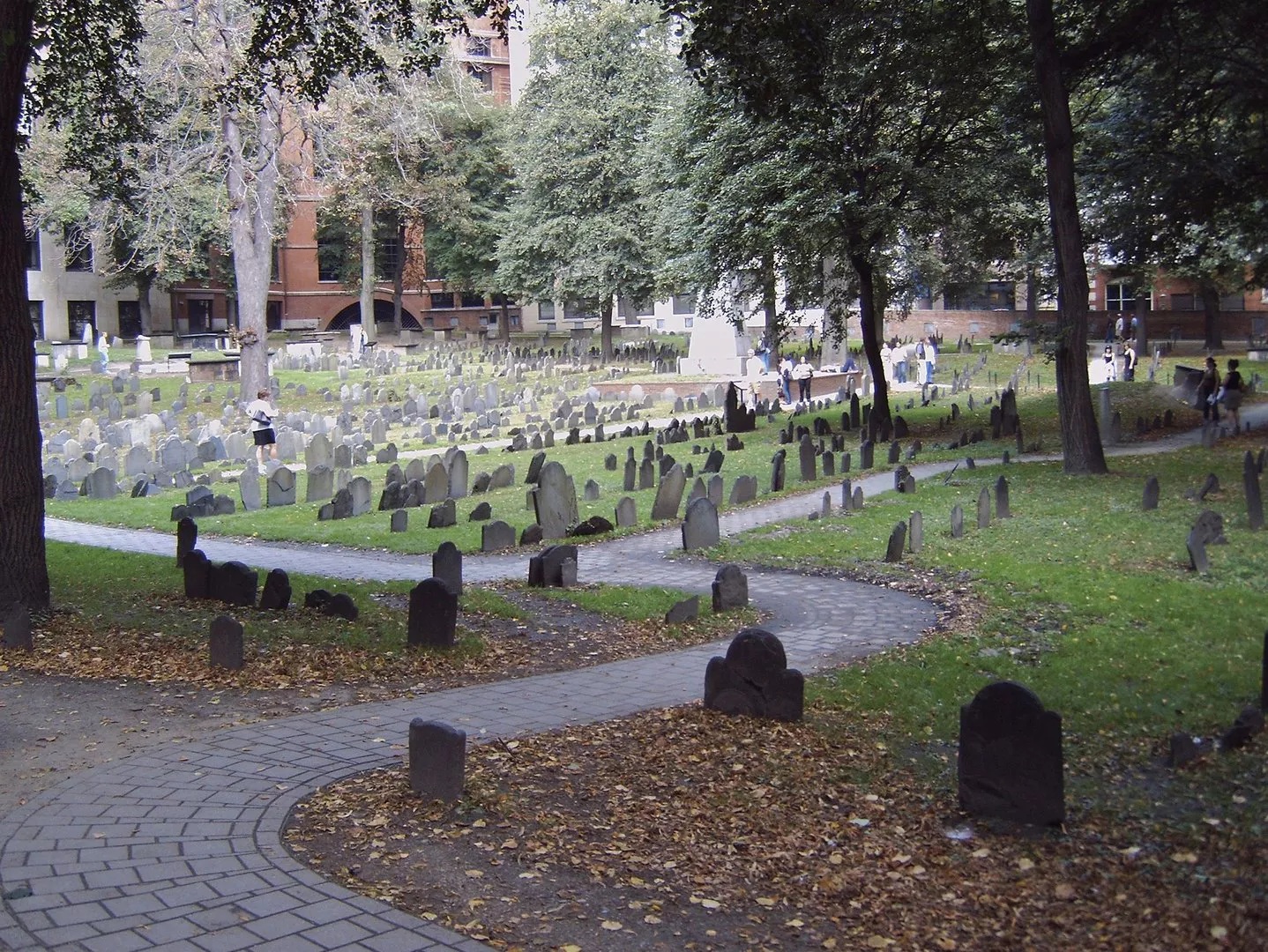 Granary Burying Ground - Boston
Investigation timeline
- 2026-09-22 — Historical file submitted.
- 2026-09-22 — Historical file accepted and published.
Research notes
Historical research: A Case Where the History May Be More Significant Than the Ghosts
History carries this file; ghosts ride along
Documented: Common’s age and uses; Great Elm as execution site; Central’s 1756 founding and social mix; 1830s and 1895 disturbances and reinterments; city caution on British officer burials. That paper trail explains why the ground invites haunting stories without proving them.
Soft: apparitions, girl ghost, trackside soldiers, hanging specters. The Rutger/girl episode is a named anecdote preserved in secondary ghost literature — better than anonymous tour blurbs, still not contemporaneous documentation. Soldier-on-the-tracks stories sit with transit folklore.
Do not upgrade “British soldiers dug up for the T” from probable tour talk to settled ID. Use Boston.gov’s careful language.
Historical research: First paranormal claim
The earliest paranormal report currently identified by this investigation dates to the 1970s and involves an alleged apparition encounter reported by Matt Rutger. While the Common and cemetery are associated with much older historical events, no earlier documented ghost reports have yet been located. Additional newspaper, folklore, and archival research may reveal earlier claims.
Open research questions
A specific gap in the file. An accepted source, research note, or further-reading link closes it.
Trace the Matt Rutger Central Burying Ground apparition account to its earliest source and determine whether documented paranormal accounts of the cemetery predate that story.
Propose evidence & media, a source citation, further reading, a research note, a correction, a related case, or a series link. Staff review before anything is added. An accepted correction does not replace the file by itself.