GG-2026-208
Emela-ntouka
- Phenomenon Cryptids & Unknown Zoology, Folklore & Cultural Encounters
- Documentation
Rating C
- A — Strong dossier: several independent sources plus primary evidence (original media, records, measurements) a researcher could use without interviewing anyone.
- B — Well documented: multiple independent witnesses with at least some contemporary primary material, or one witness with substantial primary corroboration (photos, recordings, contemporaneous notes, documents).
- C — Multi-source but soft: several witnesses or a long run of reports, but mostly testimony and after-the-fact secondary sources (newspapers, folklore collections, later interviews). Little or no primary physical evidence. Regional legend clusters such as the Bridgewater Triangle land here.
- D — Thin: single witness (or one household), little or no support beyond the account. Normal for a sincere personal experience.
- E — Incomplete or not yet assessed. Every new submission starts here until staff have read it.
- Evidence & media 2 items
- Status Historic
- Location Likouala swamp region, Likouala, Congo (Democratic Republic) · regional placement
Regional marker representing the Likouala swamp region of the Republic of the Congo associated with Emela-ntouka traditions and historical reports. Accounts extend across rivers, wetlands and communities throughout a broad and remote landscape; the marker does not identify an exact sighting, alleged killing, track or creature location.
This file is placed as a region or body of water, not a single exact event location.
Activity period
- Earliest claimed event Unknown
- Earliest documented report 1954
- Latest documented report Unknown
- Pattern Recurring
Summary
Emela-ntouka, commonly translated as “killer of elephants,” is the name applied to a large horned creature reported from the swamp forests and waterways of the Likouala region in the Republic of the Congo. In 1954, former regional wildlife inspector Lucien Blancou recorded local accounts of a dangerous animal larger than a buffalo that was said to attack elephants, buffalo and hippopotamuses when disturbed, providing the earliest firmly traceable published documentation under the Emela-ntouka name. Later descriptions emphasized a heavy rhinoceros-like body, a single prominent horn, short legs and an unusually substantial tail, while cryptozoologist Roy Mackal collected additional testimony during expeditions to the Congo in 1980 and 1981. Mackal and later writers speculated that the reports might describe a surviving ceratopsian dinosaur, while others proposed an unknown semiaquatic rhinoceros, but neither interpretation is supported by a verified specimen or diagnostic physical evidence. Emela-ntouka therefore remains an important Central African creature tradition and historical cryptozoological problem whose later “living dinosaur” identity is considerably more speculative than the original reports.
Background
Emela-ntouka is associated primarily with the river systems and extensive swamp forests of northern Republic of the Congo, particularly the Likouala region. The area's wetlands, seasonally flooded forest and difficult transportation environment have also become associated with other Central African creature traditions, most famously Mokele-mbembe. Modern cryptozoological literature sometimes combines or compares these traditions, but similarities of geography do not establish that different local names and stories describe the same physical animal.
The name Emela-ntouka is usually translated from Lingala as “killer of elephants,” reflecting the creature's most famous behavioral characteristic rather than predatory feeding. Accounts recorded in the twentieth century describe an animal that supposedly attacks elephants and other large mammals when disturbed but does not consume them. That reputation became one of the principal reasons later writers interpreted Emela-ntouka as a highly territorial herbivore rather than a carnivorous predator.
The creature's first strong documentary anchor under this name comes from 1954. Lucien Blancou, who had served as a game inspector in the region, published an article in the zoological journal Mammalia titled Notes sur les mammifères de l'Equateur Africain Français: un rhinocéros de forêt? Blancou reported local knowledge of a dangerous animal said to be larger than a buffalo and capable of disemboweling elephants. He also recorded a retrospective claim that one specimen had supposedly been killed roughly twenty years earlier near Dongou, across the Ubangi in what was then the Belgian Congo. No preserved specimen from that alleged killing entered scientific collections.
Descriptions subsequently attributed to Emela-ntouka emphasize a large, heavy animal with brownish or grey hairless skin, four stout legs, a prominent single horn on the head or snout and a large tail sometimes compared with that of a crocodile. Some accounts portray the animal as approximately elephant-sized, while Blancou's original report was more conservative in describing it as larger than a buffalo. This difference illustrates one of the central problems with the case: the standardized modern cryptid has become more anatomically specific than the earliest securely traceable documentation.
The animal is generally portrayed as semiaquatic and herbivorous. Modern summaries describe it feeding on leafy vegetation while occupying rivers, lakes and swamps. When threatened, however, it is reputed to charge large animals and use its horn to gore elephants, buffalo or hippopotamuses. These behavioral claims are central to the surviving tradition, but Gothic.Black has not established veterinary records, documented carcasses or contemporaneous wildlife reports confirming that unexplained horn wounds on elephants were caused by an unidentified species.
Roy Mackal brought renewed international attention to the creature during expeditions to the Congo in 1980 and 1981. Mackal, a University of Chicago biochemist who had become deeply involved in cryptozoological investigation, traveled primarily in search of Mokele-mbembe but also collected testimony concerning Emela-ntouka. His informants described a large horned animal said to inhabit the swamp country and attack elephants. Mackal himself did not observe or collect an Emela-ntouka, and the expeditions produced no specimen establishing an unknown species.
The most famous later interpretation proposed that Emela-ntouka might represent a surviving ceratopsian dinosaur, particularly an animal resembling Centrosaurus or related horned dinosaurs. The apparent single horn, heavy body and large tail encouraged that comparison. Mackal nevertheless encountered an immediate anatomical difficulty: witnesses did not describe the prominent bony neck frill characteristic of ceratopsians. The absence of such a major feature did not prevent the “living dinosaur” interpretation from becoming prominent in later cryptozoological literature.
The ceratopsian hypothesis also requires an enormous chronological and biogeographical leap. Ceratopsians belong to the Mesozoic fossil record and are not an established component of the modern African fauna. No recent bone, carcass, egg, trackway, DNA sample or diagnostic image has demonstrated their survival into the present. A general resemblance between selected witness descriptions and reconstructed prehistoric animals does not establish evolutionary continuity between them.
A less dramatic zoological hypothesis proposes some form of unknown rhinoceros adapted to the Congo wetlands. The comparison is understandable: a large herbivorous animal with thick skin, a heavy body and prominent nasal horn naturally suggests a rhinoceros. Indeed, Blancou's 1954 article framed the question explicitly around the possibility of a forest rhinoceros. Later cryptozoological writers have likewise proposed a previously unknown semiaquatic rhinoceros.
That hypothesis also has serious problems. Modern African rhinoceroses do not inhabit the Likouala swamp forest, possess relatively short tails compared with the heavy crocodile-like tail attributed to Emela-ntouka, and leave anatomical evidence that should ultimately be distinguishable from an unknown species. If a breeding population of elephant-sized rhinoceros-like mammals survives in Central Africa, researchers should eventually expect diagnostic tracks, dung, hair, environmental DNA, bones, carcasses or clear imagery. No such evidence reviewed for this file has established that population.
It is also possible that the tradition contains elements derived from known animals rather than one unknown species. Hippopotamuses are enormous semiaquatic mammals capable of extreme territorial aggression. Forest elephants occupy parts of the Congo Basin. Misidentified or unusually observed known animals, transferred descriptions of rhinoceroses from elsewhere in Africa, and culturally distinct creature traditions could potentially become combined when outsiders attempt to construct one standardized animal from oral accounts.
The language and cultural context therefore matter considerably. “Emela-ntouka” entered international cryptozoology largely through European and American researchers interpreting testimony collected in a colonial and postcolonial setting. Later writers frequently characterize the creature as a dinosaur and then reread earlier testimony through that assumption. To understand the underlying tradition properly, researchers need to determine which physical and behavioral attributes were independently stable among local informants before the living-dinosaur hypothesis became widely circulated.
A further complication comes from neighboring cryptid traditions. Horned semiaquatic creatures known under names such as Chipekwe in southern-central Africa and Ngoubou in Cameroon have sometimes been identified with Emela-ntouka. Similarities may represent shared folkloric motifs, exchange of stories, attempts by later cryptozoologists to unify related reports, or possibly observations of similar real animals. They should not automatically be treated as geographical reports of one species without demonstrating that the original traditions themselves made that connection.
The state of the physical evidence remains weak. Stories concerning tracks, animals supposedly killed and dead elephants attributed to Emela-ntouka appear repeatedly in later literature, but no preserved specimen has been recognized as belonging to an unidentified large mammal or dinosaur. Blancou's retrospective claim of an animal killed near Dongou is particularly frustrating because, if a body ever existed, nothing scientifically useful appears to have survived from it.
Modern Internet treatments often make the case look substantially stronger than the historical dossier supports. Some pages supply exact encounter dates, named witnesses, pursuit sequences and other detailed narratives that cannot readily be traced to Blancou, Mackal or another contemporary source. Gothic.Black does not incorporate such precision merely because the story has been repeated widely online.
For Gothic.Black, the most defensible conclusion is that Emela-ntouka represents a genuine and historically traceable Central African creature tradition that attracted serious attention from wildlife officials and later cryptozoological investigators. The 1954 record establishes that the story did not originate with modern Internet folklore. What remains unestablished is whether the tradition describes one physical animal at all, much less a surviving prehistoric species. The central research challenge is to recover the earliest local testimony independently of later dinosaur interpretations and then determine which anatomical details are truly old and which entered the tradition through subsequent cryptozoological retelling.
Witness statement
No statement on file.
Evidence & media
 The Search for the Mysterious Emela-ntouka of the Congo
Accessible overview of the Emela-ntouka tradition and the possibility proposed by some cryptozoologists that reports describe an unidentified or supposedly surviving prehistoric animal. Included as an introduction to the modern cryptid interpretation; comparisons with rediscovered species do not constitute evidence that Emela-ntouka exists.
Status: Verified
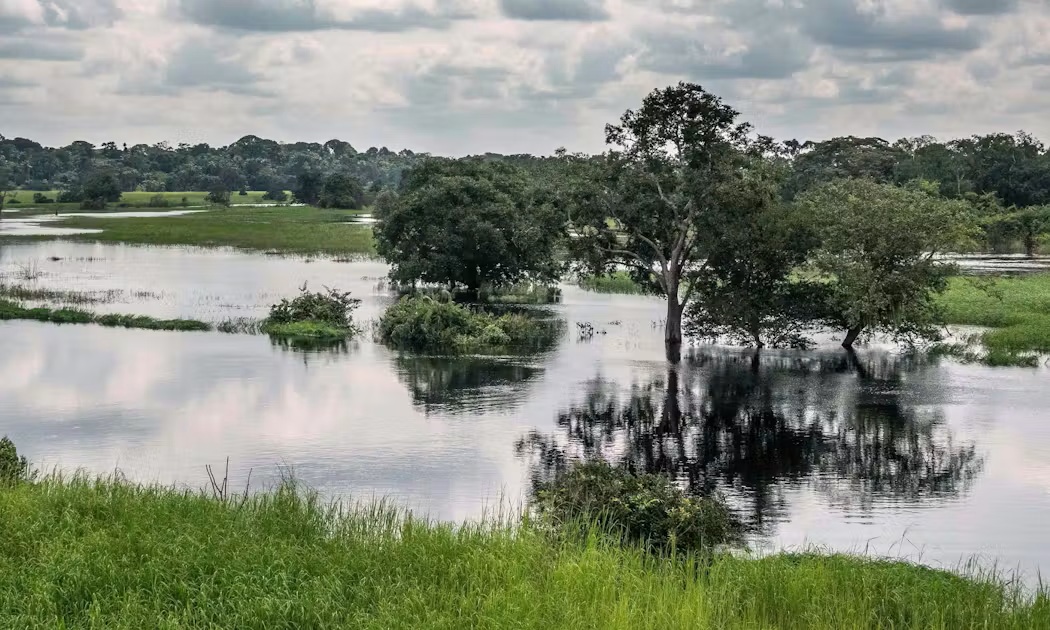
Likouala Swamp Region, Republic of the Congo
Wetland and forest landscape representative of the Likouala region associated with Emela-ntouka traditions and historical reports. The area's rivers, swamps and flooded forest form the geographic setting of the tradition; the photograph documents the environment rather than evidence of an unknown animal.
Status: Verified
Sources
- Bernard Heuvelmans. On the Track of Unknown Animals (1955)
- Lucien Blancou. Notes sur les mammifères de l'Equateur Africain Français: un rhinocéros de forêt? (1954) — Mammalia, vol. 18, pp. 358–363
- Roy Mackal. A Living Dinosaur? In Search of Mokele-Mbembe (1987) — Firsthand cryptozoological account of Roy Mackal's Congo expeditions and the testimony he collected concerning Emela-ntouka. Particularly valuable for reconstructing the modern investigation, but Mackal's surviving-ceratopsian hypothesis should be distinguished from the underlying witness reports.
Further reading
Continue exploring — Wikipedia, documentaries, podcasts, museum pages. Not treated as proof, and not independently verified by this archive.
Investigation timeline
- 2026-11-12 — Historical file submitted.
- 2026-11-12 — Research question opened
Can Lucien Blancou's complete 1954 Mammalia article and its underlying field notes be located and compared with later summaries?
- 2026-11-12 — Research question opened
Which local communities and languages supplied the original Emela-ntouka reports, and is “killer of elephants” the most accurate translation of the name in its original context?
- 2026-11-12 — Research question opened
Can the alleged animal reportedly killed near Dongou around the 1930s be traced to an identifiable witness, administrative report, specimen, photograph or other contemporary documentation?
- 2026-11-12 — Research question opened
What exact descriptions did Roy Mackal record during his 1980–1981 Congo expeditions before proposing a ceratopsian interpretation?
- 2026-11-12 — Research question opened
What is the latest reliably documented Emela-ntouka encounter supported by a named witness and contemporary record?
- 2026-11-12 — Historical file accepted and published.
Assigned GG-2026-208
Research notes
Historical research: From Forest Rhinoceros to Living Dinosaur
The title of Lucien Blancou's 1954 paper is itself instructive: un rhinocéros de forêt? or “a forest rhinoceros?” The earliest firmly traceable Western publication therefore approached the reported animal through comparison with a mammal rather than identifying it as a surviving dinosaur.
The ceratopsian interpretation became prominent later, particularly through Roy Mackal's cryptozoological work. The creature's horn, massive body and heavy tail provided superficial similarities with reconstructed horned dinosaurs, but a prominent expected feature, the ceratopsian neck frill, was absent from the testimony Mackal collected.
This raises an important provenance problem. Modern descriptions often begin by calling Emela-ntouka a possible living ceratopsian and then emphasize precisely those elements of the tradition that resemble a ceratopsian. That can create apparent confirmation through selection rather than independent convergence.
Future research should compare Blancou's exact 1954 wording and field sources with Mackal's 1980–1981 interviews and still later descriptions. Particular attention should be paid to when the large tail, specific horn structure, three-toed tracks, body size and dinosaur comparisons first occur. If those characteristics became increasingly standardized after the ceratopsian hypothesis was proposed, that development would be historically important whether or not an unidentified animal ever contributed to the original tradition.
Open research questions
A specific gap in the file. An accepted source, research note, or further-reading link closes it.
Can Lucien Blancou's complete 1954 Mammalia article and its underlying field notes be located and compared with later summaries?
Which local communities and languages supplied the original Emela-ntouka reports, and is “killer of elephants” the most accurate translation of the name in its original context?
Can the alleged animal reportedly killed near Dongou around the 1930s be traced to an identifiable witness, administrative report, specimen, photograph or other contemporary documentation?
What exact descriptions did Roy Mackal record during his 1980–1981 Congo expeditions before proposing a ceratopsian interpretation?
What is the latest reliably documented Emela-ntouka encounter supported by a named witness and contemporary record?
Propose evidence & media, a source citation, further reading, a research note, a correction, a related case, or a series link. Staff review before anything is added. An accepted correction does not replace the file by itself.