GG-2026-147
Petrozavodsk Phenomenon
- Phenomenon UFOs/UAPs
- Documentation
Rating B
- A — Strong dossier: several independent sources plus primary evidence (original media, records, measurements) a researcher could use without interviewing anyone.
- B — Well documented: multiple independent witnesses with at least some contemporary primary material, or one witness with substantial primary corroboration (photos, recordings, contemporaneous notes, documents).
- C — Multi-source but soft: several witnesses or a long run of reports, but mostly testimony and after-the-fact secondary sources (newspapers, folklore collections, later interviews). Little or no primary physical evidence. Regional legend clusters such as the Bridgewater Triangle land here.
- D — Thin: single witness (or one household), little or no support beyond the account. Normal for a sincere personal experience.
- E — Incomplete or not yet assessed. Every new submission starts here until staff have read it.
- Evidence & media 3 items
- Status Historic
- Location Petrozavodsk, Russia · regional placement
- Occurred 20 September 1977
The primary observations occurred over Petrozavodsk in Soviet Karelia, though reports were received across a large area extending into Finland and other parts of northern Europe. The map location marks the city from which the phenomenon takes its name.
This file is placed as a region or body of water, not a single exact event location.
Activity period
- Earliest claimed event 20 September 1977
- Earliest documented report 20 September 1977
- Latest documented report 20 September 1977
- Pattern Single event
Summary
The Petrozavodsk Phenomenon was a widely reported luminous aerial display observed during the early morning hours of September 20, 1977. Witnesses in Petrozavodsk and across parts of northern Europe and the Soviet Union described an unusually bright object or cloud that expanded into a glowing, jellyfish-like form and appeared to send narrow rays of light downward. The event attracted unusual scientific and official attention and contributed to the development of the Soviet Setka AN program for studying anomalous atmospheric phenomena. The strongest conventional explanation connects the principal display with the launch of Kosmos-955 from Plesetsk Cosmodrome, although researchers have continued to examine whether every report collected across the wider region can be attributed to the same event.
Background
At approximately 4:00 a.m. local time on September 20, 1977, residents of Petrozavodsk in Soviet Karelia reported an extraordinary luminous display in the pre-dawn sky. Contemporary descriptions compared the phenomenon first to a brilliant star and then to an expanding glowing form resembling a jellyfish, with narrow shafts or rays of light apparently extending downward. The display remained visible long enough to attract numerous observers and quickly became one of the best-known anomalous aerial reports of the Soviet period.
The reports were not confined to Petrozavodsk. Related luminous phenomena were reported across a broad region that included other parts of the Soviet Union and locations in northern Europe, including Finland. The wide geographic distribution of reports attracted unusual scientific and official attention. Officials in northern Europe sought clarification from Soviet scientific authorities about whether the phenomenon might have been connected with weapons testing and whether it posed an environmental risk.
Soviet scientists subsequently collected a substantial body of material concerning the September 20 phenomenon. A preliminary report prepared for the Academy of Sciences of the USSR included visual observations, radiolocation reports, physical measurements, and meteorological information. At the time, investigators concluded that the available data did not allow them to satisfactorily explain the entire phenomenon. The case subsequently contributed to the creation of Setka AN, a Soviet research program devoted to anomalous atmospheric phenomena.
A major conventional explanation was available almost immediately, however. At 01:01 UTC on September 20, the Soviet Union launched Kosmos-955 from Plesetsk Cosmodrome aboard a Vostok-2M rocket. The launch occurred shortly before the principal luminous displays were observed.
Later analysis considerably strengthened the connection between the launch and the most famous phase of the Petrozavodsk phenomenon. Northern observatories photographed an expanding luminous cloud within minutes of the launch. Researchers have shown that high-altitude rocket exhaust illuminated by sunlight while observers below remained under a darker pre-dawn sky can produce the large, luminous, ray-like form described by witnesses. This mechanism provides a strong explanation for the characteristic “jellyfish” appearance associated with the event.
That evidence makes Kosmos-955 substantially more than a convenient theory proposed years afterward. A real launch occurred at the relevant time, photographs recorded a developing luminous cloud shortly afterward, and the known behavior of illuminated high-altitude exhaust provides a physical mechanism capable of producing the principal visual display.
The remaining historical question is narrower: whether the rocket launch accounts for every observation subsequently grouped under the Petrozavodsk Phenomenon. The wider collection includes reports from different locations and, in some cases, different times or viewing directions. Later investigators who accepted a launch-related explanation for the photographed luminous cloud still questioned whether all of the collected reports could be reduced to that single event.
This distinction matters because the Petrozavodsk Phenomenon gradually became a label for a geographically broad collection of observations rather than one precisely measured trajectory. Reports from different observers should not automatically be treated as descriptions of one object merely because they occurred during the same general period.
Claims of physical effects have also become associated with the event, including later reports concerning damaged glass or unusual deposits. Soviet researchers examined some such material, but surviving documentation acknowledged that a direct causal connection between those effects and the atmospheric phenomenon had not been established.
The Petrozavodsk Phenomenon is therefore unusual because both the original observations and the principal conventional explanation can be investigated using a relatively substantial documentary record. Multiple witnesses reported a striking aerial display, Soviet newspapers covered it, scientists investigated it, and a major rocket launch occurred at nearly the same time.
The available evidence strongly supports illuminated rocket exhaust from the Kosmos-955 launch as the explanation for the best-documented jellyfish-like luminous cloud. What remains open to historical research is whether every observation later associated with the September 20 reporting wave belongs to that same launch, or whether some reports represent separate phenomena.
Witness statement
No statement on file.
Evidence & media
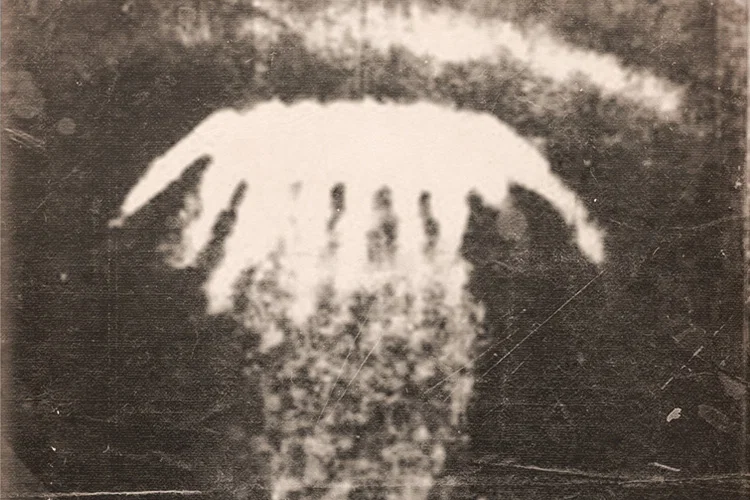
Petrozavodsk Phenomenon Photograph
Widely reproduced photograph associated with the Petrozavodsk Phenomenon. The image shows the characteristic canopy-shaped luminous structure that many witnesses compared to a jellyfish suspended above the horizon.
Status: Attributed
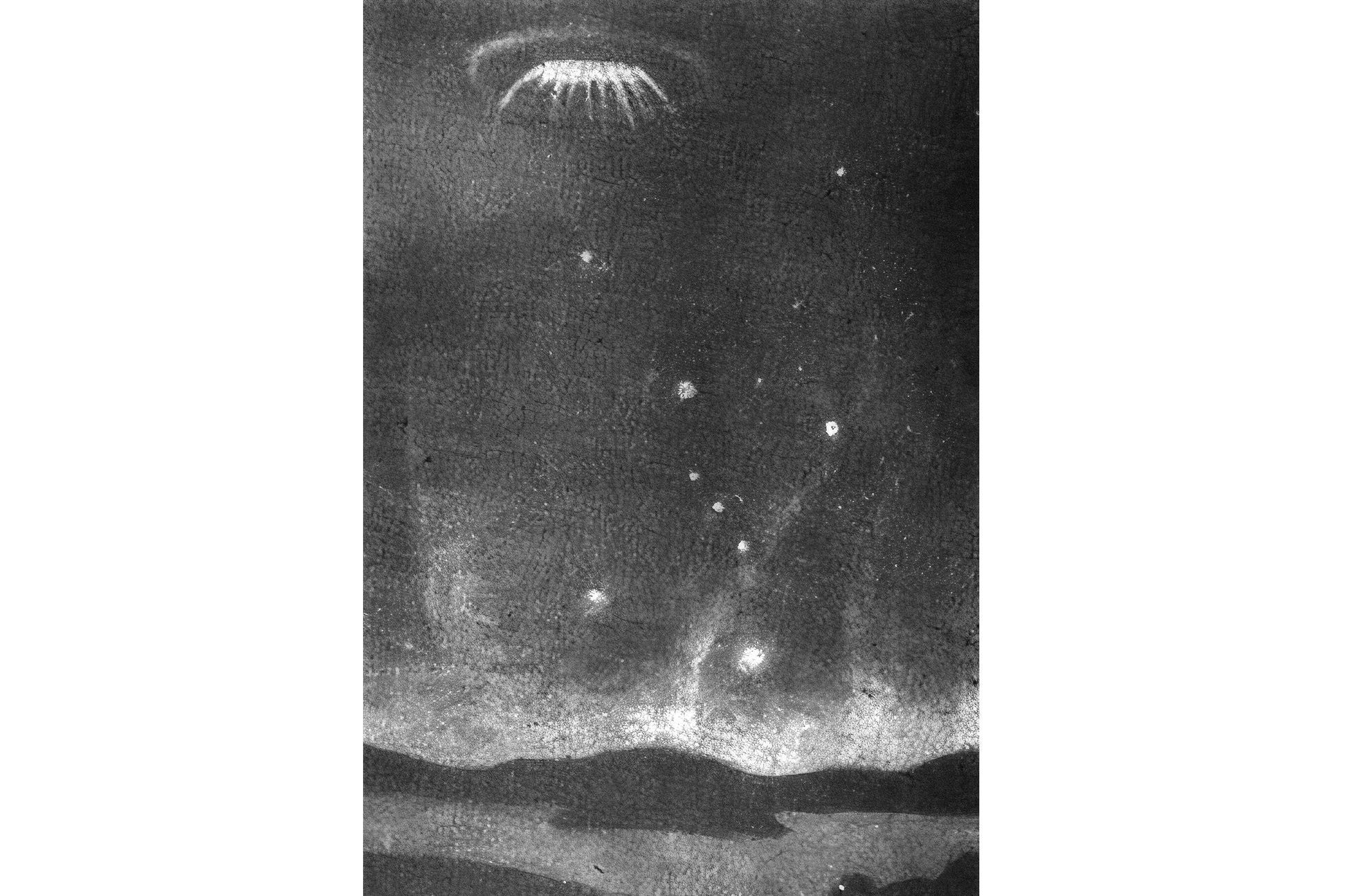
Petrozavodsk Witness Illustration
Contemporary illustration depicting the luminous "jellyfish" form reported over Petrozavodsk during the events of September 20, 1977. Witnesses described a glowing object that appeared to radiate numerous beam-like rays across the pre-dawn sky.
Status: Verified
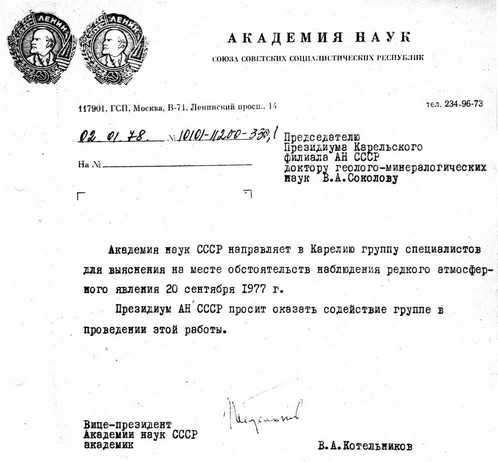
Academy of Sciences Investigation Letter
Official correspondence from the Academy of Sciences of the USSR concerning the investigation of the September 20, 1977 atmospheric phenomenon. The event generated sufficient scientific interest to prompt formal inquiry and field investigation by Soviet researchers.
Status: Verified
Investigation timeline
- 2026-11-03 — Historical file submitted.
- 2026-11-03 — Research question opened: How many independent witness reports survive today?
- 2026-11-03 — Research question opened: What radar and instrumental records remain available?
- 2026-11-03 — Research question opened: Did all reported observations derive from the Kosmos-955 launch?
- 2026-11-03 — Historical file accepted and published.
Research notes
No curated research notes.
Open research questions
A specific gap in the file. An accepted source, research note, or further-reading link closes it.
Which original or near-contemporary witness reports from the September 20, 1977 phenomenon survive, and where are they archived?
What radar and instrumental records remain available?
Which September 20, 1977 observations can be matched to the Kosmos-955 launch, and which reports fall outside the launch's documented timing or viewing geometry?
Propose evidence & media, a source citation, further reading, a research note, a correction, a related case, or a series link. Staff review before anything is added. An accepted correction does not replace the file by itself.