GG-2026-055
Green Children of Woolpit
- Phenomenon Folklore & Cultural Encounters
- Documentation
Rating C
- A — Strong dossier: several independent sources plus primary evidence (original media, records, measurements) a researcher could use without interviewing anyone.
- B — Well documented: multiple independent witnesses with at least some contemporary primary material, or one witness with substantial primary corroboration (photos, recordings, contemporaneous notes, documents).
- C — Multi-source but soft: several witnesses or a long run of reports, but mostly testimony and after-the-fact secondary sources (newspapers, folklore collections, later interviews). Little or no primary physical evidence. Regional legend clusters such as the Bridgewater Triangle land here.
- D — Thin: single witness (or one household), little or no support beyond the account. Normal for a sincere personal experience.
- E — Incomplete or not yet assessed. Every new submission starts here until staff have read it.
- Evidence & media 1 item
- Status Historic
- Location Woolpit, England · approximate placement
Approximate marker representing Woolpit, Suffolk, where the medieval chronicles place the discovery of the Green Children. The precise location of the alleged discovery cannot now be established, and this marker should not be interpreted as the location of a known archaeological or historical site connected with the story.
Activity period
- Earliest claimed event Unknown
- Earliest documented report Circa 1196
- Latest documented report Unknown
- Pattern Single event
Summary
Sometime in the twelfth century, according to two medieval chroniclers, workers near Woolpit, Suffolk, discovered two children whose skin appeared green and whose language could not be understood. The children initially refused unfamiliar food but eagerly ate beans. Over time, the surviving girl learned English and lost her green coloration, while the boy became ill and died. When the girl could communicate, she reportedly described a homeland illuminated by perpetual twilight. William of Newburgh's version calls it St. Martin's Land, while Ralph of Coggeshall gives a somewhat different account of how the children reached Woolpit. The story survives only through medieval chroniclers writing after the alleged events, leaving unresolved whether it preserves a distorted historical episode, a medieval wonder tale, or some combination of the two.
Background
Woolpit is a village in Suffolk, several miles east of Bury St Edmunds. Its name derives from the wolf pits once associated with the area, and those pits became part of one of medieval England's strangest stories: the appearance of two children whose skin was reportedly green.
The story survives principally in the works of two medieval chroniclers, William of Newburgh and Ralph of Coggeshall. William, an Augustinian canon in Yorkshire, included the episode in his Historia rerum Anglicarum. Ralph, abbot of the Cistercian monastery at Coggeshall in Essex, recorded another version in his Chronicon Anglicanum. The accounts were written in the late twelfth and early thirteenth centuries rather than at the moment the children supposedly appeared.
William placed the event during the reign of King Stephen, between 1135 and 1154. According to his account, people working near Woolpit discovered two children, a boy and a girl, near one of the pits. Their skin appeared green, their clothes seemed unfamiliar, and nobody could understand the language they spoke.
The children reportedly refused the food they were offered until they encountered beans, which they recognized and ate eagerly. As the children gradually adapted to other food, their green coloration was said to fade. The boy remained sickly and died, while the girl survived, learned the local language, and became integrated into the community.
Only after learning to communicate could the surviving girl supposedly explain where she and her brother had come from. This is also where the two medieval accounts begin to diverge in important ways.
In William's version, the girl described a place called St. Martin's Land, whose inhabitants were Christian and particularly revered Saint Martin. The country had no ordinary bright sunlight; instead, the children described a twilight-like illumination. William's account says the children had been tending their father's animals when they heard bells and somehow found themselves near Woolpit.
Ralph's version preserves the same basic idea of a strangely illuminated homeland but does not call it St. Martin's Land. His account instead describes the children entering a cavern while tending animals and following the sound of bells until they eventually emerged near Woolpit. The unfamiliar brightness of the outside world reportedly overwhelmed them when they emerged.
The two chroniclers also differ in some details about what happened afterward. Ralph says the surviving girl entered the household of a local knight and was baptized. William reports that the girl eventually married. Neither medieval chronicle gives her the modern name sometimes attached to the story, so later attempts to identify her more precisely should not be treated as part of the original account.
These differences matter because the Green Children story is often retold today as though one detailed medieval eyewitness report survives. It does not. What survives are two later written accounts that agree on the central features while differing in some important details. Modern scholarship has consequently examined not only whether the story records a historical event, but also what purpose the episode may have served within each chronicler's work.
Broadly, explanations fall into two categories.
One possibility is that the story preserves a distorted memory of real children who became lost or displaced and were unfamiliar to the people around Woolpit. Their strange language, clothing, restricted diet, and unusual appearance could then have acquired more fantastic characteristics as the story was repeated. The reported disappearance of their green coloration after adopting a new diet has also encouraged later attempts to find a medical or nutritional explanation. These possibilities remain interpretations rather than conclusions established by the medieval sources.
The other approach treats the Green Children principally as folklore or a medieval wonder tale. The underground or twilight homeland, mysterious passage into another country, unfamiliar children, and transformation after eating local food all fit comfortably within a world in which chroniclers recorded marvels alongside material intended as history. Modern scholars have accordingly examined the story's literary, religious, and cultural functions rather than assuming that every element was intended as literal reportage.
Neither interpretation can now be demonstrated conclusively. There is no contemporary physical evidence associated with the children, no surviving account written by the girl, and no independent record capable of confirming where the children came from.
What is historically secure is narrower but still fascinating: two medieval chroniclers preserved closely related stories about strangely colored foreign-speaking children appearing at Woolpit, surviving initially on beans, with the boy dying and the girl adapting to local life.
Whether that shared narrative began with actual displaced children, a story already transformed through oral transmission, medieval folklore, or some combination of history and legend remains unresolved.
Witness statement
No statement on file.
Evidence & media
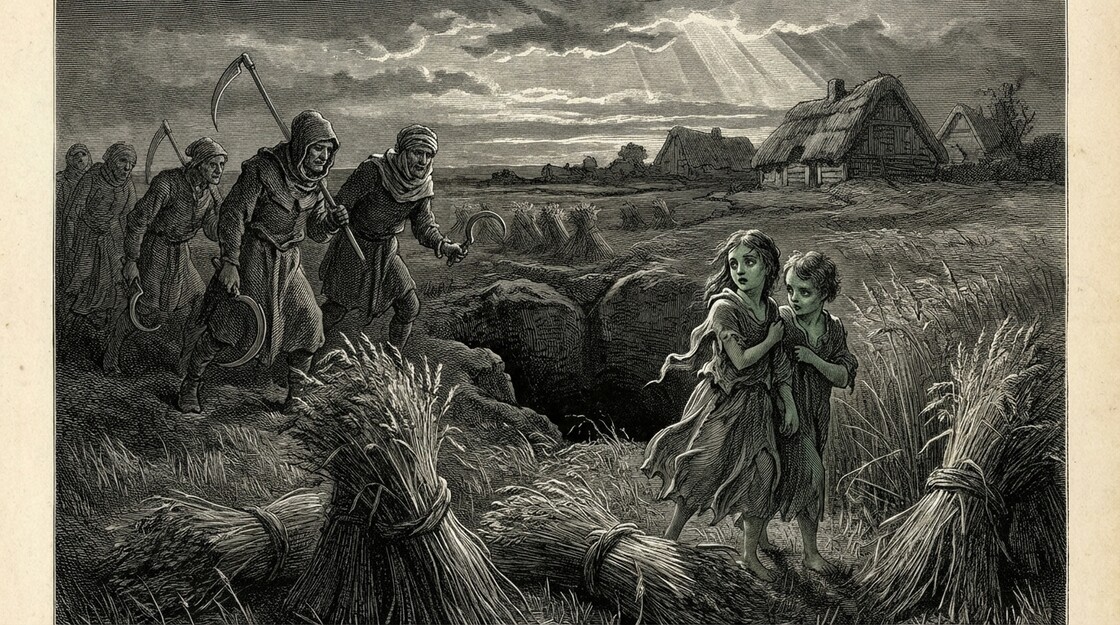
Green Children Discovery
Illustration depicting the 12th-century English folk legend of the Green Children of Woolpit.
Further reading
Continue exploring — Wikipedia, documentaries, podcasts, museum pages. Not treated as proof, and not independently verified by this archive.
Investigation timeline
- 2026-09-25 — Historical file submitted.
- 2026-09-25 — Historical file accepted and published.
Assigned GG-2026-055
Research notes
Historical research: Folkloric, Historical, and Medical Context
In academic medieval studies and historical folklore, the narrative of the Green Children of Woolpit is primarily analyzed as a blend of localized historical displacement, dietary illness, and traditional Anglo-Flemish folkloric motifs.
Historical analysts, such as Paul Harris, propose that the children were Flemish immigrants displaced during the 1173 battle at Fornham St. Martin, where hundreds of Flemish mercenaries and weavers were slaughtered. Suffering from severe hypochromic anemia—historically termed "chlorosis" or "green sickness," caused by severe malnutrition—their skin exhibited a greenish hue that dissipated upon adopting a iron-rich diet. The "unknown language" described by chroniclers William of Newburgh and Ralph of Coggeshall was likely a regional Flemish dialect misunderstood by Suffolk villagers. Folklorists further note that medieval narratives frequently incorporated fairy-tale tropes—such as green-skinned underworld entities, subterranean realms, and broad beans associated with the dead—to absorb and mythologize traumatic historical events.
Historical research: nresolved Parapsychological and Anomaly Questions
While socio-historical models offer rational explanations for physical displacement, several persistent anomalies in the primary chronicler accounts prevent a complete dismissal of the case's high strangeness:
Topographical and Environmental Discrepancies: Primary contemporary sources emphasize that the surviving girl described an inhabited, twilight realm ("St. Martin's Land") characterized by subterranean acoustics and distinct atmospheric conditions. Chronicler William of Newburgh, known for his rigorous verification standards regarding contemporary phenomena, explicitly noted that he hesitated to report the incident but felt compelled due to multiple trustworthy witnesses.
Flemish Hypothesis Contradictions: Skeptics of the Flemish refugee theory point out that Woolpit sat along major East Anglian trade routes where Flemish traders were commonplace; local villagers and landowners like Sir Richard de Calne would have easily recognized Flemish speech or traditional continental garments. The persistent description of non-terrestrial apparel and immediate disorientation leaves open questions regarding potential dimensional slips, localized portal phenomena, or ultra-terrestrial encounters within British folklore.
Open research questions
A specific gap in the file. An accepted source, research note, or further-reading link closes it.
Trace the earliest surviving versions of the Green Children narrative in the accounts of William of Newburgh and Ralph of Coggeshall.
Identify which details are shared between the earliest sources, which details differ between the chronicles, and which elements of the modern story first appear in later retellings, folklore collections, speculative interpretations, or popular media.
Propose evidence & media, a source citation, further reading, a research note, a correction, a related case, or a series link. Staff review before anything is added. An accepted correction does not replace the file by itself.